ABOUT
BIO
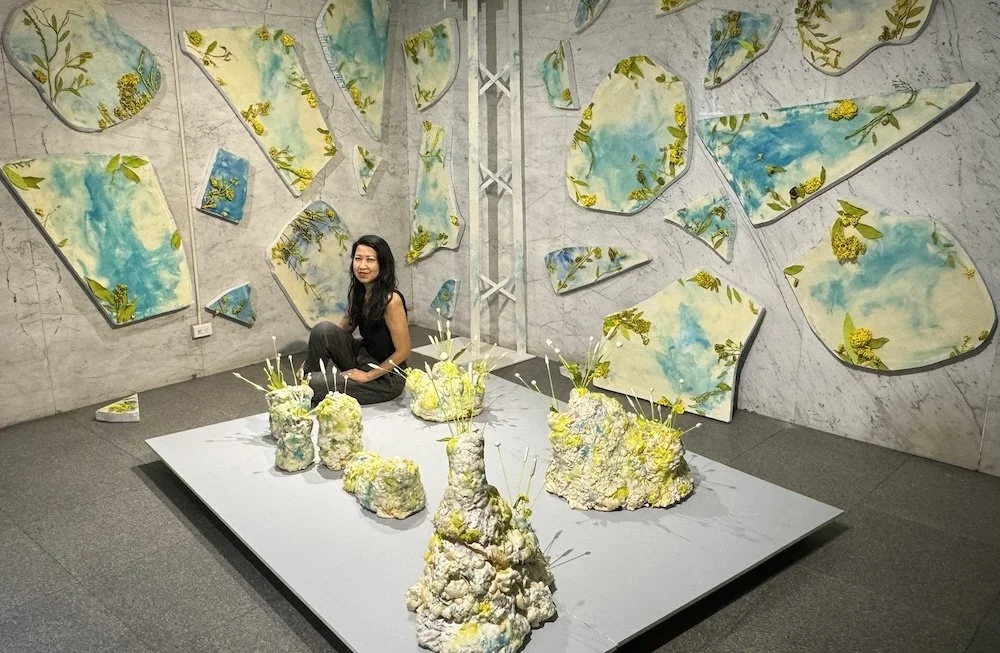
Cecile Chong is a New York–based multidisciplinary artist whose research-informed practice investigates how materials, objects, languages, and living forms carry histories of movement, ecological knowledge, and cultural exchange across generations and geographies. Born in Ecuador to Chinese parents and raised in Quito and Macau, her work draws on lived experiences across the Americas and Asia.
Her public art installations include Held & Holding for Queens Botanical Garden (2026), Chicken Little: Líneas de Falla / Fault Lines for WhiteBox at 42nd Street/MTA (2026), Chicken Little: Lost in Transmission for Art in Buildings, 125 Maiden Lane (2024), Prickly Issues at MakerPark (2024), and EL DORADO – The New Forty Niners, presented across the five boroughs of New York City (2017–2022). Chong is the recipient of a Pollock-Krasner Foundation Grant and has received fellowships, residencies, and grants from organizations including the New York State Council on the Arts (NYSCA), the Puffin Foundation, Art Omi, Marble House Project, Surf Point Foundation, Dieu Donné Workspace, the Joan Mitchell Center, and KODA.
Her solo exhibitions include Q Galería at Universidad San Francisco de Quito, Kates-Ferri Projects, Smack Mellon, Sugar Hill Children's Museum, and Kenise Barnes Fine Art. She has also exhibited at El Museo del Barrio, the Nevada Museum of Art, The Bronx Museum of the Arts, CUE Art Foundation, and Wave Hill. Her work is held in the collections of the Smithsonian Institution, El Museo del Barrio, the Studio Museum in Harlem, the Museum of Chinese in America, the Rockefeller Foundation, the Long Island Museum, and other public and private collections in the United States, Europe, Latin America, and Asia. Reviews of her work have appeared in Hyperallergic, The Brooklyn Rail, Whitehot Magazine, Artnet, and The New York Times. Chong received an MFA from Parsons School of Design, an MA in Education from Hunter College, and a BA in Studio Art from Queens College. She is a member of the Elizabeth Foundation for the Arts Studio Program in New York.
Artist statement
Cecile Chong is a New York–based, research-driven multidisciplinary artist whose work investigates how materials, objects, languages, and living forms carry histories of migration, ecological knowledge, and cultural exchange across generations and geographies. Born in Ecuador to Chinese parents and shaped by diasporic experiences across the Americas and Asia, she approaches migration as one expression of the continual movement of people, ideas, and materials that has shaped human history.
Working across painting, ceramics, installation, public art, and participatory projects, Chong treats making as a form of research. She works through materials, allowing their histories, physical properties, and cultural associations to guide the questions she asks. Porcelain, volcanic ash, wax, botanical forms, handwritten languages, and recurring Guagua figures become active carriers of memory, adaptation, and exchange, revealing the journeys across landscapes, cultures, and time.
Chong creates immersive environments that reveal the relationships connecting people, places, and the natural world. Her work invites viewers to consider how histories of movement and exchange continue to shape our lives today, reminding us that connection has always existed across cultures, landscapes, and generations. Through this lens, she explores resilience, reciprocity, and our shared humanity.